
December 20, 2025, Saturday of the Third Week of Advent
Lectionary #196, Luke 1: 26-38
Scripture
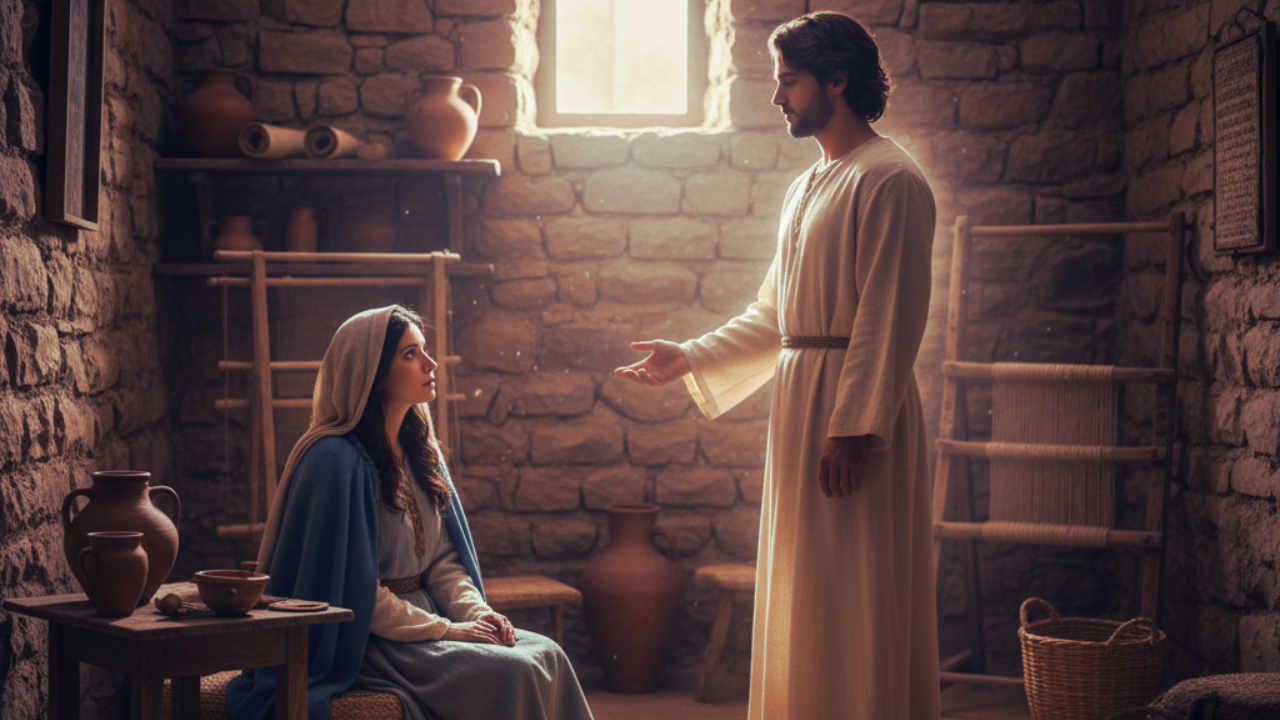
In the sixth month, the angel Gabriel was sent from God to a town of Galilee called Nazareth, to a virgin betrothed to a man named Joseph, of the house of David, and the virgin’s name was Mary. And coming to her, he said, “Hail, full of grace! The Lord is with you.” But she was greatly troubled at what was said and pondered what sort of greeting this might be. Then the angel said to her, “Do not be afraid, Mary, for you have found favor with God. Behold, you will conceive in your womb and bear a son, and you shall name him Jesus. He will be great and will be called Son of the Most High, and the Lord God will give him the throne of David his father, and he will rule over the house of Jacob forever, and of his Kingdom there will be no end.”
But Mary said to the angel, “How can this be, since I have no relations with a man?” And the angel said to her in reply, “The Holy Spirit will come upon you, and the power of the Most High will overshadow you. Therefore, the child to be born will be called holy, the Son of God. And behold, Elizabeth, your relative, has also conceived a son in her old age, and this is the sixth month for her who was called barren; for nothing will be impossible for God.”
Mary said, “Behold, I am the handmaid of the Lord. May it be done to me according to your word.” Then the angel departed from her.
Reflection
The great theologian and teacher, Karl Rahner, in one of his last letters, wrote to a young German drug addict who had asked him for help. The addict had said, “You theologians talk about God, but how could this God be relevant in my life? How could this God get me off drugs? Rahner said to him, “I must confess to you in all honesty that for me God is and has always been an absolute mystery. I do not understand what God is; no one can. We have intimations, inklings; we make faltering, inadequate attempts to put mystery into words. But there is no word for it, no sentence for it.”
And talking to a group of theologians in London, Rahner said, “The task of the theologian is to explain everything through God, and to explain God as unexplainable.” Unexplainable mystery. One does not know, one cannot say. One says, “Ah, ah…” (Anthony de Mello, S.J., Awareness, the Perils and Opportunities of Reality, New York: Doubleday, 1992), page 124).
The Annunciation is a revelation from God, in which God reveals to a woman what God wants from her. The Evangelist Luke states that Mary was “perplexed.” Any person would have been at least perplexed. Luke also adds the angel’s reassurance: “Do not be afraid, Mary, for you have found favor with God.” Mary had a right to be afraid of such a manifestation, whatever its nature.
At La Salette, the two children, Maximin and Melanie, had to be reassured by the Beautiful Lady: “Do not be afraid. I am here to tell you great news.” Otherworldly manifestations are frightening because we know so little about that world. The mystery of it overwhelms us. These children also had a perfect right to be afraid.
We cannot forget that one of the reasons for the gospels is precisely to reassure us that God is not our enemy. Even St. Paul, the scholar and lifelong student of God, has to declare what must have been clear to him: “If God is for us, who can be against us?” Surely one of the most extraordinary acts of faith in history is the one we meet today in this story of the Annunciation. We learn that the best way to meet God is through belief. Fortunately, we don’t know it through an exposé but through the example of Mary. We see how she reacted during her encounter with God.
Her response was: “Here am I, the servant of the Lord; let it be done to me according to your word.” Her faith is meant to be a witness. When we consider that the Scriptures could have revealed God as only as powerful, all-wise, the Creator of the Universe, the Master over life and death, and everything in between, we can marvel at the masterpieces of revelation we actually have before us today. God chose to be revealed as loving, compassionate, caring, healing, and saving. This theme is prevalent throughout all of the Sacred Scriptures.
La Salette Invocation
Our Lady of La Salette, reconciler of sinners,
pray without ceasing for us who have recourse to you.