
December 16, 2025, Tuesday of the Third Week of Advent
Lectionary #188, Matthew 21: 28-32
Scripture
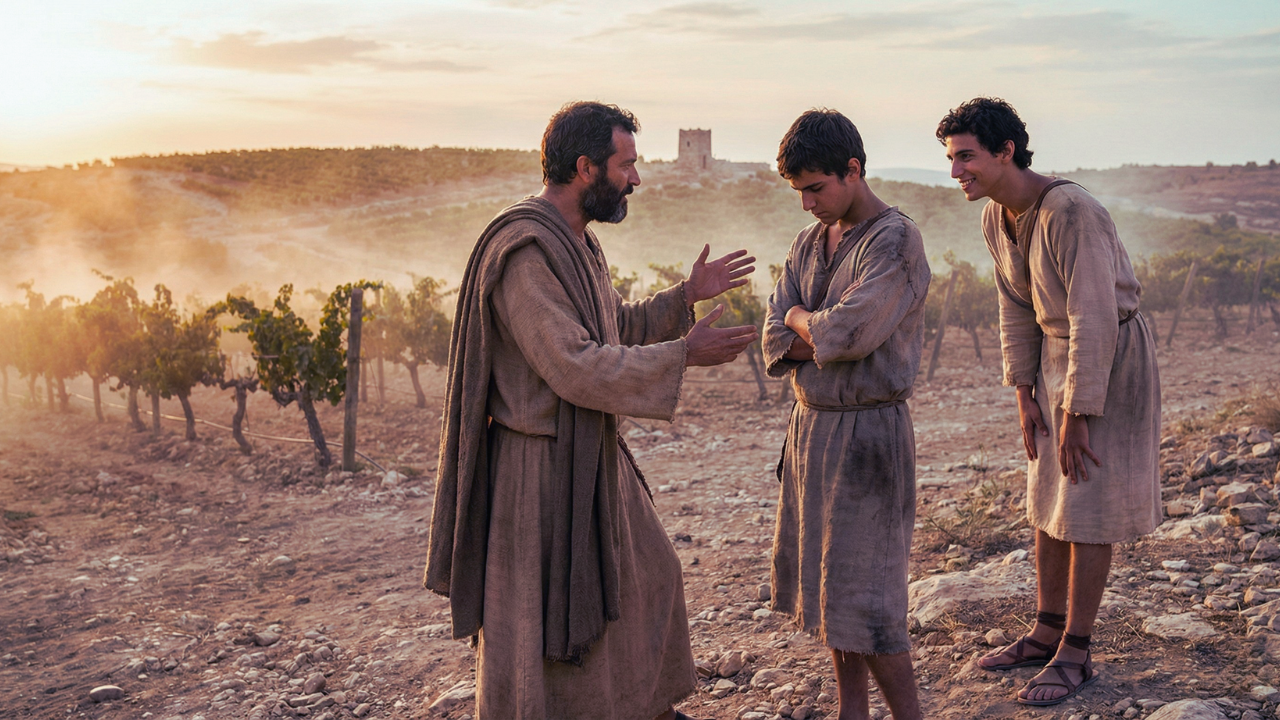
Jesus said to the chief priests and the elders of the people: “What is your opinion? A man had two sons. He came to the first and said, ‘Son, go out and work in the vineyard today.’ The son said in reply, ‘I will not,’ but afterwards he changed his mind and went. The man came to the other son and gave the same order. He said in reply, ‘Yes, sir,’ but did not go. Which of the two did his father’s will?” They answered, “The first.” Jesus said to them, “Amen, I say to you, tax collectors and prostitutes are entering the Kingdom of God before you. When John came to you in the way of righteousness, you did not believe him; but tax collectors and prostitutes did. Yet even when you saw that, you did not later change your minds and believe him.”
Reflection
Matthew, the gospel writer, has a special liking for the words to do’. For him, to do was the heart and soul of religion and fidelity to Christ. This Matthew was an orderly type of person. His gospel is a masterpiece of meticulously ordered craftsmanship where each word is accounted for. So, when Matthew makes frequent use of a particular word, like ‘to do’, one does well to take notice.
Here are some examples of Matthew’s use of “do”: (The words in parentheses are the English equivalent of the Greek.)
Matthew 1,24: “When Joseph awoke from sleep, he did as the angel of the Lord had commanded him.”
Matthew 3,8: “Bear (or do) fruit worthy of repentance.”
Matthew 5,19: “Whoever does them (that is, the commandments) and teaches them will be called great in the kingdom of heaven.”
Matthew 7,12: “In everything do to others as you would have them do to you.”
Matthew 7,24: “Everyone then who hears these words of mine and acts (or does) on them will be like a wise man who built his house on rock.
Matthew 7,26: “And everyone who hears these words of mine and does not act (or do) them will be like a foolish man who built his house on sand.”
Christ has just engaged in a controversy with the Jews over authority. They had heard the prophet John the Baptist, but refused to do God’s will through him. Christ will ask the crucial question after having explained the situation of the two sons: one who said he would not go but went to his father in the end, and the other, who said he would go but never did. “Which of the two did the will of his father?” The answer was. and is clear.
We note that both sons are the children of God. The argument will bear not on what they are (pious, moral, or not), nor on what they say, but on what they will or will not do, as Bonnard notes (see Tuesday, week 2). And then, “the man” of the gospel, who is God, says to each of his sons, “Son, go and work in the vineyard today.” This man is no dreamer lost in the coming of some future bliss. Both sons are placed under the same conditions, and both must demonstrate their willingness to comply with the father’s instructions. They are really asked to prove their love.
At La Salette, the Lady began her discourse with the most important of issues: “If my people refuse to submit.” All else falls under this general heading. This is really the cause of the Son’s displeasure and of the Mother’s tears. It is also the cause of our own unhappiness and societal ill health.
The ills that the Lady brings to the fore are not, at first sight, catastrophic. But, like the quiet forces of erosion or rot, they gnaw on the fabric of life and slowly destroy it. “Doing” the will of God is the heart of gospel teaching. The four gospels and all the other books of the New Testament make this the very core of the good news.
There is a world of difference between knowing, hearing, and doing. Our Lady also made it her priority at La Salette.
La Salette Invocation
Our Lady of La Salette, reconciler of sinners,
pray without ceasing for us who have recourse to you.