
Introduction
There is a quiet familiarity about Mary that can make us think we already know her.
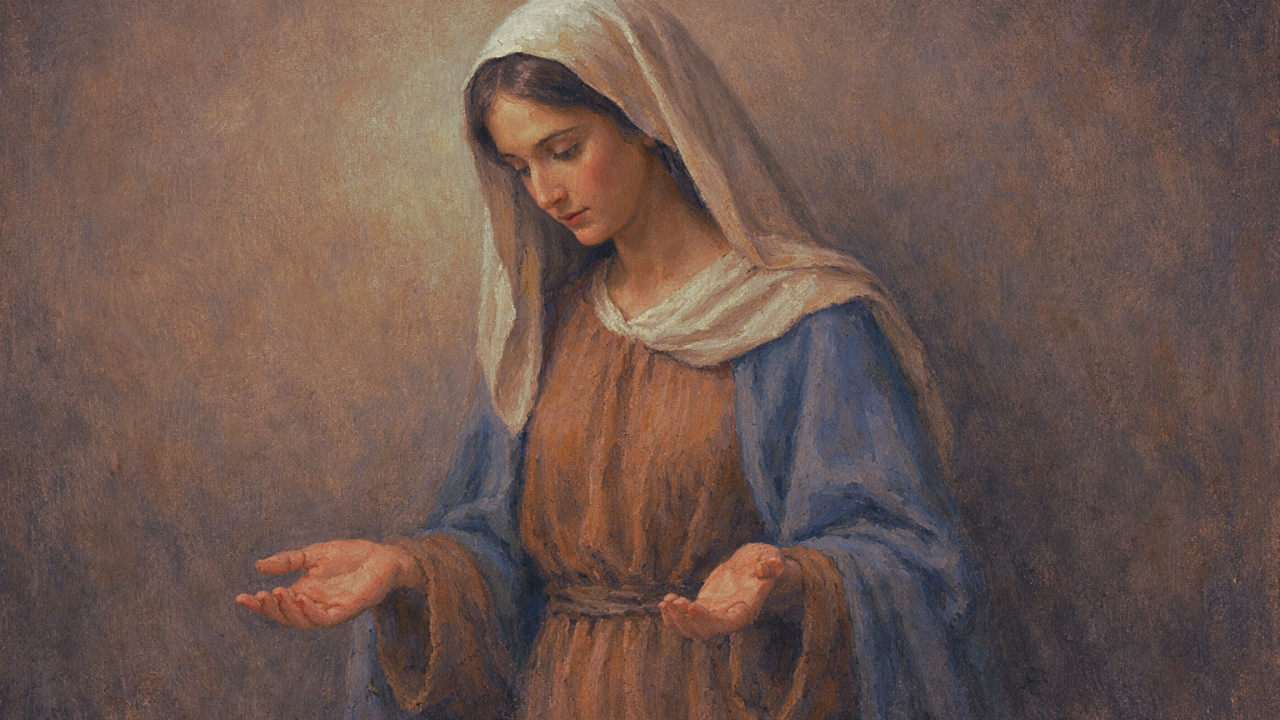
Perhaps the image comes from childhood: a pale blue mantle, folded hands, eyes lowered in serene devotion. Or perhaps it is a statue tucked into the corner of a church, candles flickering nearby. For many of us, Mary entered our spiritual imagination early and remained there: unchanged, stable, reassuring.
And yet, when we pause long enough to look again, we begin to notice something surprising: Mary does not always look the same.
Across centuries, cultures, and spiritual movements, the face of Mary has shifted, not because she changes, but because we do. Each generation, facing new hopes and fears, has learned to recognize in her a different reflection of the Gospel. Like light passing through stained glass, the same Mary reveals new colors depending on the moment in history and the heart that beholds her.
To walk through the changing face of Mary is not to dilute devotion, but to deepen it. It is to discover how profoundly she belongs to the Church, to humanity, and to our own unfolding journey of faith.
Mary and Our Identity as Children of God
Saint Paul’s Letter to the Galatians offers a powerful foundation for understanding Mary’s place in Christian life, not as an isolated figure of devotion, but as one deeply connected to who we are in God’s sight.
When the fullness of time had come, God sent his Son, born of a woman, born under the law, to ransom those under the law so that we might receive adoption as children… So you are no longer a slave but a child, and if a child, then also an heir, through God (Galatians 4:4–7, 28b–29, NJB).
Mary enters salvation history precisely at this turning point: the “fullness of time.” She stands at the threshold where humanity is no longer defined by fear or slavery, but by adoption, intimacy, and inheritance. Her role is not self-generated. It is entirely relational. She is who she is because of what God does in her and through her. And this truth is essential, especially when misunderstandings about Marian devotion arise.
Thomas Merton, writing with great clarity and humility, addressed a common misconception: that Catholics place Mary on a level with Christ or attribute to her a glory that belongs to God alone. In fact, the opposite is true. Mary’s greatness lies not in self-assertion but in radical availability. Her holiness flows from her consent, her receptivity, her freedom from ego that allows God’s mercy to act without resistance. (1)
Seen this way, Mary becomes not a distant ideal character, but a living witness to what it means to belong wholly to God, just as Saint Paul describes the vocation of every baptized believer.
Reflection
Mary’s Glory: God’s Work, Not Her Own
At the heart of authentic Marian devotion lies a paradox: Mary’s greatness is rooted in her “nothingness.” This is not a diminishment of her dignity but its fullest expression. She does not cling to a self-made identity. She does not grasp at privilege. She does not obstruct grace with fear or self-protection. Instead, she becomes transparent to God.
Merton describes her as the perfect instrument, not because she loses her personhood, but because she becomes fully herself. Freedom, in Mary, is not the freedom to assert, but the freedom to trust. Obedience, in her, is not submission under compulsion, but love responding to love. (2)
This vision of Mary has profound implications. It invites us to reconsider what holiness looks like in our own lives. It challenges the modern temptation to define worth by productivity, visibility, or control. Mary shows us a different path: holiness as availability, dignity as receptivity, freedom as trust.
The Gospel Portraits: One Woman, Many Facets
Already within the Gospels themselves, Mary appears differently depending on the evangelist.
In Mark’s Gospel, she remains largely in the background, and her brief appearance leaves an unresolved tension. She is part of Jesus’ human story, yet the focus remains firmly on discipleship and the cost of following Christ.
Matthew presents Mary quietly but decisively. Joseph stands at the forefront, yet Mary’s role as the mother of the Savior is essential, anchoring the mystery of the Incarnation in human obedience.
Luke offers the richest portrait. Here Mary is both mother and disciple: she is the one who listens, questions, consents, and treasures God’s word in her heart. She embodies the Church in its purest form: hearing the Word and giving it flesh.
John, writing later, moves even further into symbolism. Mary stands at Cana, attentive to human need, and at Calvary, where she becomes mother not only to Jesus but to all disciples. In John’s vision, Mary belongs not only to the past but to the ongoing life of the Church. (3)
From the very beginning, then, Mary resists a single definition. She is always the Mother of the Lord, yet never confined to one role or one image.
Across the Centuries: Mary in the Life of the Church
As Christian consciousness developed, so too did the ways believers understood and related to Mary.
In the early centuries, theologians like Justin Martyr and Irenaeus recognized Mary as the New Eve. Just as Eve’s disobedience contributed to humanity’s fall, Mary’s obedience participates in humanity’s restoration. Where death entered through refusal, life enters through consent. Mary becomes mother not only of Jesus, but of all who are reborn in Christ. (4)
During the age of the Fathers of the Desert, when martyrdom gave way to a more ascetic way of living, Mary was seen through the lens of virtue and discipline. She embodied purity, withdrawal, and spiritual focus, sometimes in ways that feel distant to modern sensibilities, yet reflective of the era’s spiritual priorities. (5)
In the Middle Ages, shaped by chivalry and courtly ideals, Mary emerged as Queen and Lady. She was honored as the fairest and most noble of women, inspiring courage, loyalty, and devotion. Saints like Bernard of Clairvaux spoke of her as one who goes before us, inviting confidence and hope. (6)
The Renaissance softened the image again. Artists portrayed Mary as tender mother, human and affectionate, holding the Christ Child with warmth and intimacy. She became not only Queen of Heaven but mother of us all, close to human vulnerability and love. (7)
Later centuries, marked by rationalism and materialism, emphasized Mary’s strength. She appeared as a valiant Queen and merciful advocate, standing firm against forces that threatened faith and meaning, sometimes expressed through imagery that, while theologically imperfect, spoke powerfully to anxious hearts. (8)
The nineteenth and twentieth centuries brought the great Marian apparitions (La Salette, Lourdes, Fatima) where Mary appeared not simply to console, but to warn and invite conversion. Her beauty was matched by urgency. She called the Church back to repentance, prayer, and fidelity at moments of cultural upheaval. (9)
In our own time, the Church increasingly presents Mary as the perfect disciple, first among believers, model of faith, and image of the Church itself. She is honored not only for her maternity, but for her trust, courage, and freedom. (10)
Seen across time, Mary’s changing face does not fragment devotion; it reveals its depth.
Mary and La Salette: A Face Shaped by Compassion
Within the La Salette tradition, Mary appears deeply attentive to human suffering. When her message reaches new cultures, whether in India, Brazil, or elsewhere, people instinctively recognize her concern for daily life: for harvests, labor, sustenance, and survival.
She is not distant from the struggles of the poor. She is Queen of the Harvest, Mother of Reconciliation, one who weeps not out of weakness but out of love wounded by indifference.
Here, Mary’s face reflects both sorrow and hope. She does not condemn; she calls. She does not abandon; she accompanies.
Application
Learning to See Mary (and Ourselves) Anew
To reflect on the changing face of Mary is to accept an invitation: to allow our own faith to mature.
Perhaps the image of Mary we received early in life no longer speaks as strongly. That does not mean it was wrong. It means we are being invited to see more deeply.
Mary grows with us, not because she changes, but because we do.
She invites us to move from external devotion to interior relationship, from habit to encounter. She teaches us that holiness is not static, that faith must engage the real questions of each age, and that discipleship requires attentiveness, courage, and humility.
Like Mary, we are called to let God act freely within us. Like Mary, we are invited to become instruments of reconciliation in a fractured world. Like Mary, we learn that our truest identity lies not in control, but in belonging.
Questions for Your Reflection
- What images or experiences of Marian devotion have shaped your faith journey?
- Which Gospel portrayal of Mary speaks most powerfully to you today, and why?
- How has your understanding of Mary changed as your own life and faith have matured?
- What title or image of Mary best expresses what you need in this season of life?
- In what ways might Mary be inviting you to greater trust, humility, or reconciliation?
Conclusion
Mary continues to reveal her face wherever hearts are open to conversion, healing, and hope. At the National Shrine of Our Lady of La Salette, pilgrims encounter not only her image, but her ongoing invitation to reconciliation and renewed faith.
We invite you to deepen your journey, through prayer, retreat, pilgrimage, or ongoing reflection. Subscribe to our blog, join us for an upcoming retreat, or come walk the sacred grounds where Mary’s message continues to echo: “Come closer, my children.”
FIND OUT MORE about the National Shrine of Our Lady of La Salette or EXPLORE PROGRAMS AND RETREATS offered at our La Salette Retreat Center.
Prayer
Memorare to Our Lady of La Salette
Remember, Our Lady of La Salette, true Mother of Sorrows,
the tears you shed for us on Calvary.
Remember also the care you have taken to keep us faithful to Christ, your Son.
Having done so much for your children, you will not now abandon us.
Comforted by this consoling thought, we come to you pleading,
despite our infidelities and ingratitude.
Virgin of Reconciliation, do not reject our prayers, but intercede for us,
obtain for us the grace to love Jesus above all else.
May we console you by a holy life
and so come to share the eternal life Christ gained by his cross. Amen.
Invocation:
Our Lady of La Salette, Reconciler of Sinners,
pray without ceasing for us who have recourse to you.
Footnotes
(1) Thomas Merton, New Seeds of Contemplation (Abbey of Gethsemani / New Directions, 1962), 171–173.
(2–10) Patrick Bearsley, S.M., The Changing Face of Mary, Marist Spirituality Resources, https://www.maristspirituality.org/the-changing-face-of-mary/.