
December 4, 2025, Thursday of the First Week of Advent
Lectionary #178, Matthew 7: 21, 24-27
Scripture
Jesus said to his disciples: “Not everyone who says to me, ‘Lord, Lord,’ will enter the Kingdom of heaven,
but only the one who does the will of my Father in heaven.
“Everyone who listens to these words of mine and acts on them will be like a wise man who built his house on rock. The rain fell, the floods came, and the winds blew and buffeted the house. But it did not collapse; it had been set solidly on rock. And everyone who listens to these words of mine but does not act on them will be like a fool who built his house on sand. The rain fell, the floods came, and the winds blew and buffeted the house. And it collapsed and was completely ruined.”
Reflection
There are still many people who try to get down to the bedrock basics of life. We say that life is too short to waste on second-rate issues. As the years progress, we wonder if we have squandered too many hours and days poking at life instead of living it. Today’s gospel reading has much to say about this, and the passage is not one of those soaring speeches and oft-quoted verses that are the stuff of sanctuary banners. You will not often find the “will of God” on posters or in retreat slogans.
And yet it should be displayed prominently on church steeples alongside the cross and all the artwork. Nothing in the gospels and indeed, all of world literature, proves the worth of love more than the oneness of it. To do the will of the beloved is love’s heaviest burden and most delightful challenge. We sing of love’s manifold unions, but none has a firmer grasp and a warmer clasp than `wasting’ one’s strength and committing one’s life to the velvet task of pleasing the other.
This type of union with God is expressed in the gospel as entering the Kingdom. The Kingdom of God is God’s life and heart. The “only” person who will enter that heart and that kingdom is the one who seeks and finds ways of pleasing the beloved. Doing God’s will, by the way, cannot improve God’s lot or fortune, and so, doing His will means what St Irenaeus defined it to be back in the second century: “God’s will is man alive.” Aside from the gender-bias, this is the pithiest description ever written of the will of God.
In this world of meetings, retreats, seminars, encounters, and conventions focused on priorities, this priority holds the highest rating. It is helpful to understand the importance of this will of God, as this passage forms part of the Sermon on the Mount. It is Christ’s first of five great sermons in Matthew and is, in itself, a compendium of the entire Gospel.
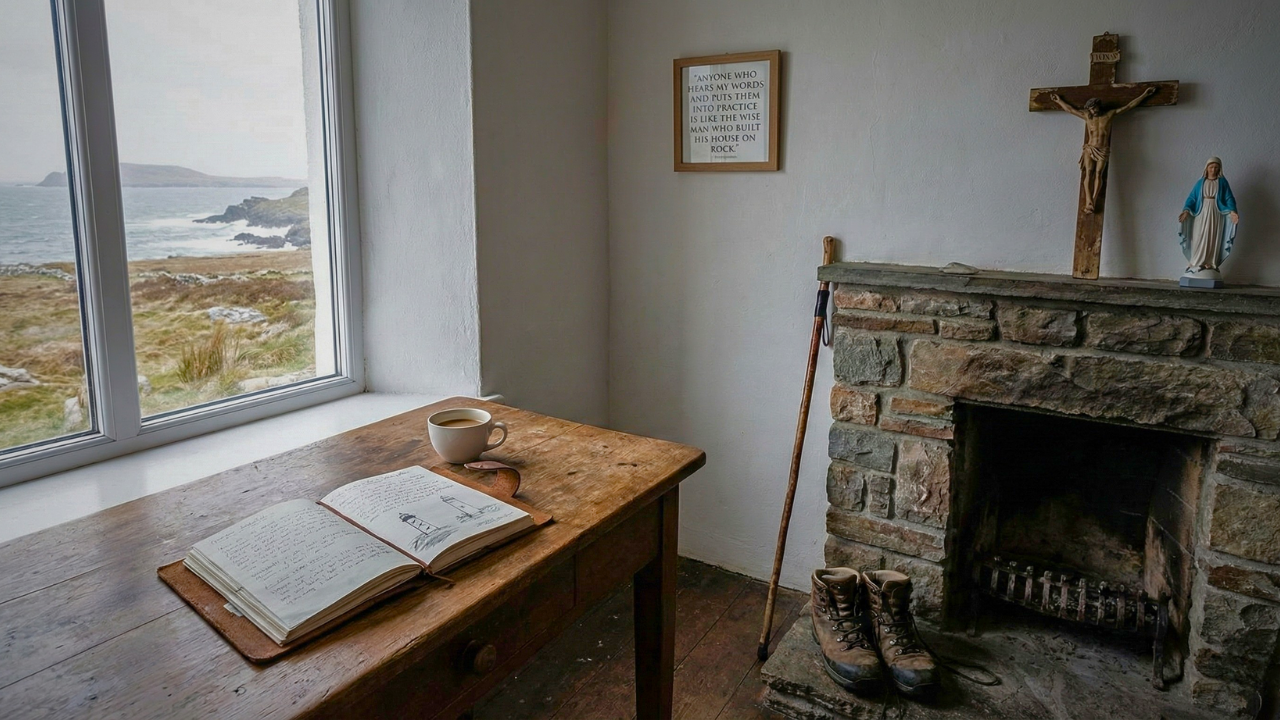
People on the continent have been seeking wisdom since the beginning of time. Here, Christ says, “Anyone who hears my words and puts them into practice is like the wise man who built his house on rock..” There is no more comforting word in the world for us buffeted and beaten and weeping humans than this blanket guarantee of soul-strength and wisdom. The rains come and the winds blow strong enough to roil the oceans, but this man’s house stands because it has been “solidly set on rock.”
When the beautiful Lady appeared at La Salette, she invited the children to come close to her: “Come closer, my children, don’t be afraid. I am here to tell you great news.”
The great news she had in mind contained many different items but she had one overriding concern to share with the children: “If my people will not submit, I will be forced to let go the arm of my Son. It is so strong and so heavy that I can no longer hold it back.” The mother of the Lord comes directly to the point of our religion and our existence. Her first sentence deals with obedience and submission, admittedly, no Gallup poll popularity winners in our day. That first declaration encompasses the entire discourse. Indeed, the discourse only itemizes this first statement. We see the will of God mentioned in the Lord’s first sermon of His ministry, and we see the very same idea in the first place in the Lady’s discourse. Surely, they’ve been talking to each other.
The gospel is Revelation, and the discourse does not oblige anyone to believe in it for salvation. But since the Lady was sent to pronounce it, it would be rash not to heed it. For those of us who seek soul tranquility and serenity of heart, doing the will of God (doing God’s thing) is a must. For fullness of life and for fulfillment of the heart, both the gospel and the discourse are on a parallel course. The Lady came to remind us that our happiness and joy were still on God’s mind.
La Salette Invocation
Our Lady of La Salette, reconciler of sinners,
pray without ceasing for us who have recourse to you