
INTRODUCTION
There are moments in the life of faith when a familiar name suddenly becomes personal.
Perhaps it happens quietly, while praying the Rosary, standing before a statue, or hearing a Marian hymn you have known since childhood. Perhaps it happens unexpectedly, at the bedside of a loved one, in grief, or in a moment of deep vulnerability. Suddenly, Mary is no longer a distant figure from Christmas cards or stained-glass windows. She feels near. Attentive. Maternal.
For many Christians, this moment marks a shift. Mary is no longer only the mother of Jesus, but she becomes a mother. This is not accidental. It is woven into the mystery of salvation itself.
CONTEXT
“When the fullness of time had come…”
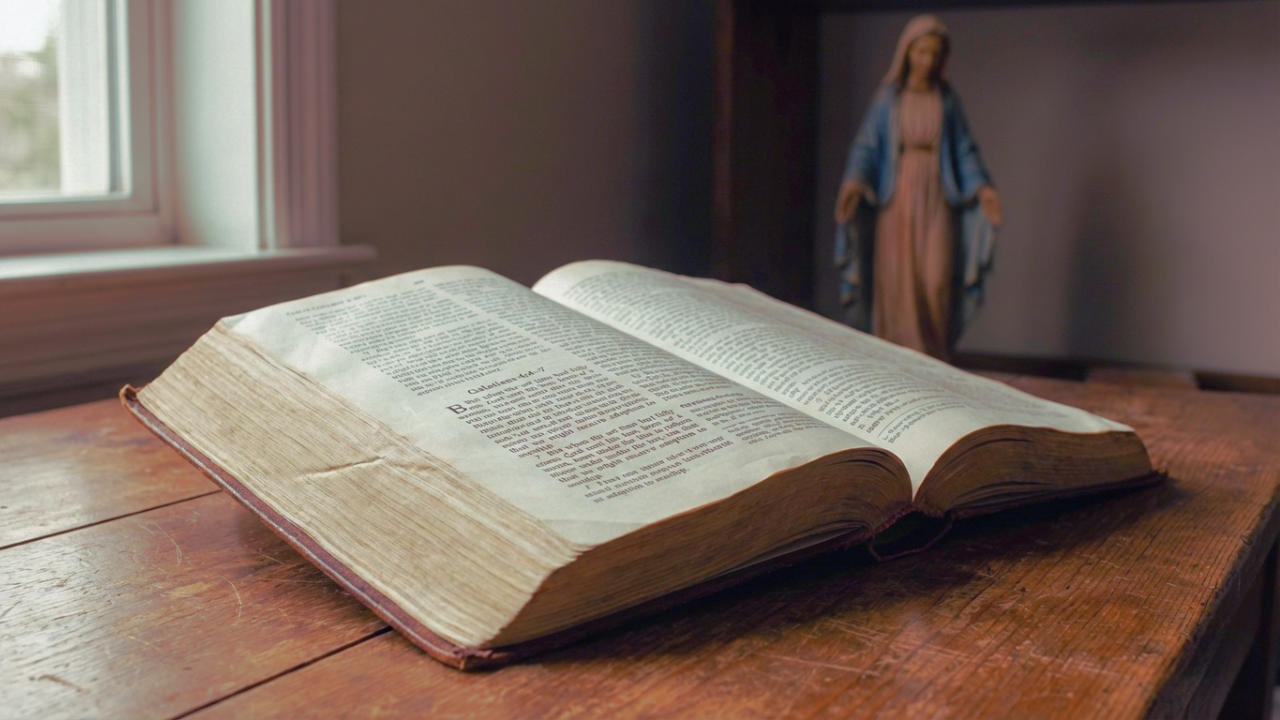
Saint Paul offers one of the most concise and profound summaries of the Incarnation in his Letter to the Galatians:
“But when the fullness of time had come, God sent his Son, born of a woman, born under the law, to ransom those under the law so that we might receive adoption. As proof that you are children, God sent the spirit of his Son into our hearts, crying out, ‘Abba, Father!’ So you are no longer a slave but a child, and if a child, then also an heir through God.” (Gal 4:4–7, NJB)
Paul does not name Mary. Yet everything hinges on her.
The Son is born of a woman. God’s eternal plan enters history through a real human mother, rooted in a people, a covenant, a story. Mary stands at the crossroads of divine initiative and our human freedom. Through her “yes,” salvation enters the world and takes flesh and blood.
Paul’s passage situates Mary not on the margins of the Christian faith, but at its heart. Yes, because through Mary, we are drawn into adoption. Through her Son, we learn to cry, “Abba, Father.”
REFLECTION
Mary: More Than an Individual Woman
Christian tradition has always struggled to find adequate language for Mary, not because she overshadows God, but because love seeks expression. As Cardinal John Henry Newman once observed, love has its own language, and Marian devotion flows from affection rooted in faith. When the Church calls Mary “our life, our sweetness, and our hope” in the Salve Regina, it speaks the language of love. God alone remains our ultimate life and hope, and yet Mary leads us toward Him in a uniquely human way.¹
The New Testament presents Mary in a paradoxical manner. At once, she is central but almost hidden. Acclaimed by the angel as the mother of the long-awaited Messiah, she recedes during Jesus’ public ministry. She reappears at decisive moments: beneath the Cross, among the disciples awaiting the Spirit, and finally within the symbolic visions of the Apocalypse. There, she appears not as a solitary figure but enveloped in the splendor of the Church itself.²
This is not accidental. Mary is not merely an individual believer with an extraordinary role. She is the Daughter of Zion, the representative of God’s faithful people. What the Church is called to become collectively is first realized personally in her.
Mary and the Church: A Living Relationship
Catholic Tradition has long recognized a profound bond between Mary and the Church. Mary is not outside the Church, nor above it. She is within it as its most eminent member. As Saint Augustine once expressed with striking clarity: the dignity of man is honored in the flesh of Christ, and the dignity of woman is honored in the mother of Christ.³
The Second Vatican Council deliberately chose to integrate Marian doctrine within its teaching on the Church, rather than isolating it. This was not a diminishment of Mary, but a rediscovery of her true place. The Council taught that Mary is both the personal realization of the Church and the bride of Christ in her fullness. What the Church hopes to become in holiness, obedience, and communion has already been embodied in Mary.
In this sense, the Church is Marian. Mary communicates her spirit to the Church not by replacing Christ, but by forming disciples who listen, trust, and remain faithful even when understanding falters.
APPLICATION
Standing at the Foot of the Cross
Nowhere is Mary’s role more clearly revealed than at Calvary.
From a narrative perspective, Jesus’ words to Mary and the Beloved Disciple constitute a formal last will. In the ancient world, a condemned man could bequeath his possessions by word alone. Now, on the cross, Jesus has nothing left: no property, no wealth, no legacy to distribute. His only earthly possession is his mother. And he gives her away.⁴
In doing so, Jesus dies in complete poverty.
Yet this act is not only material; it is relational. Jesus establishes a real act of adoption. In Jewish law, adoption was not symbolic. It was binding, permanent, and transformative. Mary becomes the mother of the Beloved Disciple, and he truly becomes her son.
The Gospel emphasizes the disciple’s response: “From that hour, the disciple took her to his own home” (Jn 19:27). This phrase signifies more than shared lodging. It means Mary is received into the disciple’s life as his own (his family and his identity).
Only after this act is completed does the Gospel declare that “all was now finished.” Only then does Jesus surrender his spirit. The fate of Mary mattered deeply to him.
The Beloved Disciple—and Us
John’s Gospel has long been called the “spiritual Gospel” because its events unfold on multiple levels. The Beloved Disciple is not merely a historical figure; he represents the ideal disciple, the one who abides, listens, and loves. His anonymity invites every reader to step into his place.⁵
If this is so, then Jesus’ words from the Cross are addressed not only to John, but to every disciple: “Behold, your mother.”
This relationship is not biological. It is born from suffering, from the “hour” of Jesus’ passion. Mary becomes our mother through the birth pangs she experiences at the foot of the Cross. Her maternal care flows from sacrifice, fidelity, and love that remains when all else collapses.⁶ To take Mary into our lives, then, is obedience to Jesus’ final gift.
PRAYER
Dedication to Our Lady of La Salette
Most holy Mother, Our Lady of La Salette,
who for love of me shed such bitter tears
in your merciful apparition,
look down with kindness upon me,
as I dedicate myself to you without reserve.
From this day, my glory shall be to know that I am your child.
May I so live as to dry your tears
and console your afflicted heart.
Beloved Mother,
to you and to your blessed charge and sacred keeping
and into the bosom of your mercy,
for this day and for every day,
and for the hour of my death
I commend myself, body and soul,
every hope and every joy, every trouble and every sorrow,
my life and my life’s end.
O dearest Mother,
enlighten my understanding, direct my steps,
console me by your maternal protection,
so that exempt from all error,
sheltered from every danger of sin,
I may, with ardor and invincible courage,
walk in the paths traced out for me
by you and your Son. Amen.
Invocation
Our Lady of La Salette, Reconciler of Sinners,
pray without ceasing for us who have recourse to you.
QUESTIONS FOR REFLECTION
- What were you taught about Mary when you were younger, and how has your understanding changed over time?
- Who are the people in your life who have “mothered” you through sacrifice, presence, or quiet fidelity?
- What sacrifices has your own mother or a maternal figure made that you are only now beginning to understand?
- What might it mean for you personally to “take Mary into your home,” as the Beloved Disciple did?
- How might standing more deeply with Mary help you understand Jesus more clearly?
Mary never draws attention to herself. She always leads us to her Son and to the community of believers shaped by His love.
In this spirit, we invite you to visit the National Shrine of Our Lady of La Salette and/or La Salette Retreat Center in Attleboro MA for prayer, pilgrimage, or during one of our retreats and allow Mary, Mother, Disciple, and Reconciler, to accompany your walk of faith.Discover opportunities for reflection, healing, and spiritual renewal at:
https://lasaletteattleboroshrine.org/
https://www.lasaletteretreatcenter.org/