
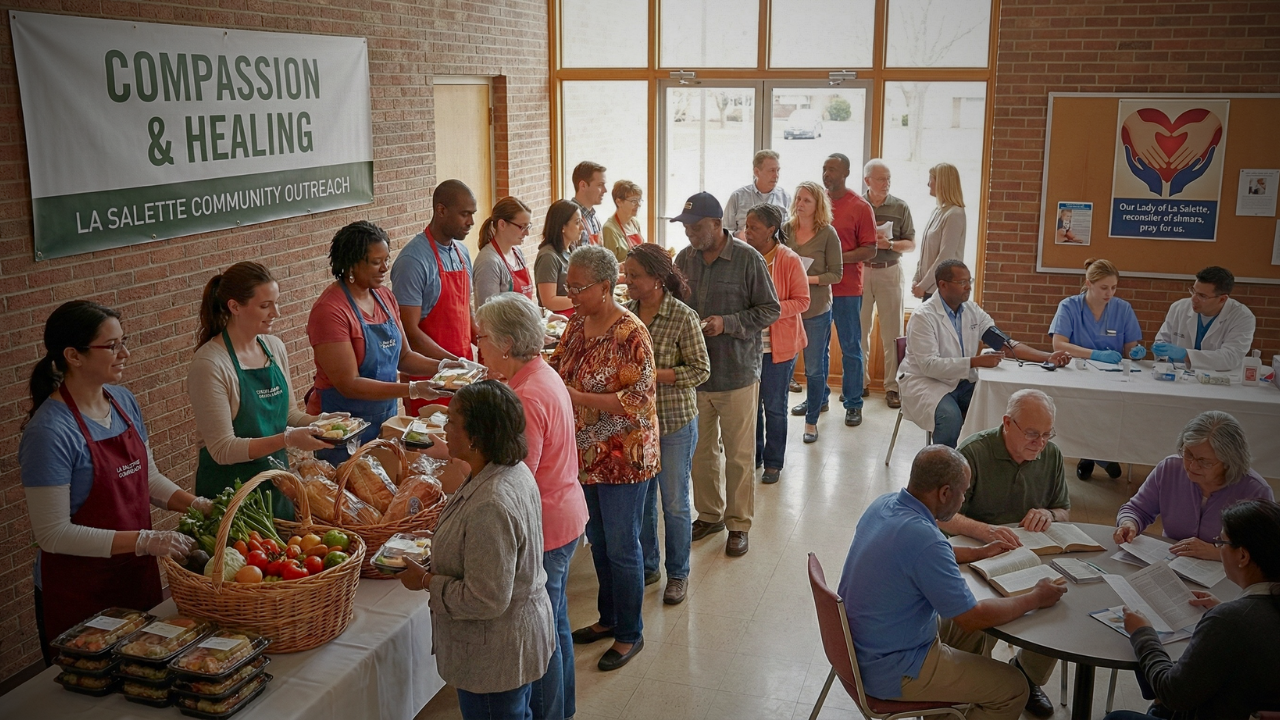
December 3, 2025, Wednesday of the First Week of Advent
Lectionary #177, Matthew 15: 29-37
Scripture
At that time, Jesus walked by the Sea of Galilee, went up on the mountain, and sat down there. Great crowds came to him, having with them the lame, the blind, the deformed, the mute, and many others. They placed them at his feet, and he cured them. The crowds were amazed when they saw the mute speaking, the deformed made whole, the lame walking, and the blind able to see, and they glorified the God of Israel.
Jesus summoned his disciples and said, “My heart is moved with pity for the crowd, for they have been with me now for three days and have nothing to eat. I do not want to send them away hungry, for fear they may collapse on the way.” The disciples said to him, “Where could we ever get enough bread in this deserted place to satisfy such a crowd?”
Jesus said to them, “How many loaves do you have?” “Seven,” they replied, “and a few fish.” He ordered the crowd to sit down on the ground. Then he took the seven loaves and the fish, gave thanks, broke the loaves, and gave them to the disciples, who in turn gave them to the crowds. They all ate and were satisfied. They picked up the fragments left over–seven baskets full.
Reflection
The gospels tell their story with more than one purpose in mind. They speak of Jesus’ ministry to the people of his time, and these stories become more than just stories, but calls to the people of all time to learn what kind of Person this Christ is. Matthew multiplies the types of illnesses that Christ dealt with, and this leads us to imagine that there were many more than he names here. These cures are visibly physical and hint at the message that Christ also came to save people from spiritual and soul diseases. Christ loved people and used His power to alleviate suffering; this is not belaboring the obvious. The clear message is that God does not want people to suffer.
The gospel shows us something unique about the heart of Christ. Whenever he is “moved with pity” in the presence of suffering, he acts on this pity. This is not easy-chair love and theoretical concern. It was not to prove His power that He produced food out of nowhere, but because “they have been with me three days, and have nothing to eat. I do not want to send them away hungry, for fear they may collapse on the way.”
There is strong, implied praise of Christ here. The disciples make a point of saying that this is a vast crowd, and there is precious little food available. When Jesus inquires, the disciples tell Him that all they have is seven loaves of bread and a few small fish.
Christ takes the initiative. Christ is aware. The gospel reveals to us a Christ who is mindful of the conditions and situations, as well as the people around Him. He may be prayerful and contemplative. He is not asleep.
This miracle underlines Christ’s generosity. It is characteristic of God that he never gives just enough, except perhaps to prove a point. He deals in abundant and overwhelming gifts. Matthew makes sure we know that “All ate until they were full.” One is left with the impression that possessive skimping is abhorrent to Him. He deals in open-handed magnanimity and gives new meaning to `largesse’. “When they gathered up the fragments left over, these filled seven hampers.” This crowd was not to go home hungry.
At La Salette, Mary reminded the world that Christ has not fallen asleep. The poverty of the village of La Salette in 1846 gave misery a bad name. People were impoverished in every aspect: morally, spiritually, financially, and materially. The Lady shed tears and revealed that nineteen centuries after the resurrection, God was still “moved with pity.” He was awake and caring enough to send His mother to the people of the world.
The message of La Salette highlights the ills and threats that need to be healed. But time has not changed the heart of a generous Lord. “If they are converted, rocks and stones will turn into heaps of wheat, and potatoes will be self-sown in the fields.”
Seven hampers of leftover food in the Lord’s miracle, people healed of all manner of illnesses and diseases, stones turned into heaps of wheat and self-sown potatoes: we are dealing here with Someone who wants to protect His reputation for munificence. Promises, threats, healings, cures, abounding food, tears—a lot happens before the “arm of my Son” comes down.
However, that is also done out of love.
La Salette Invocation
Our Lady of La Salette, reconciler of sinners,
pray without ceasing for us who have recourse to you.