
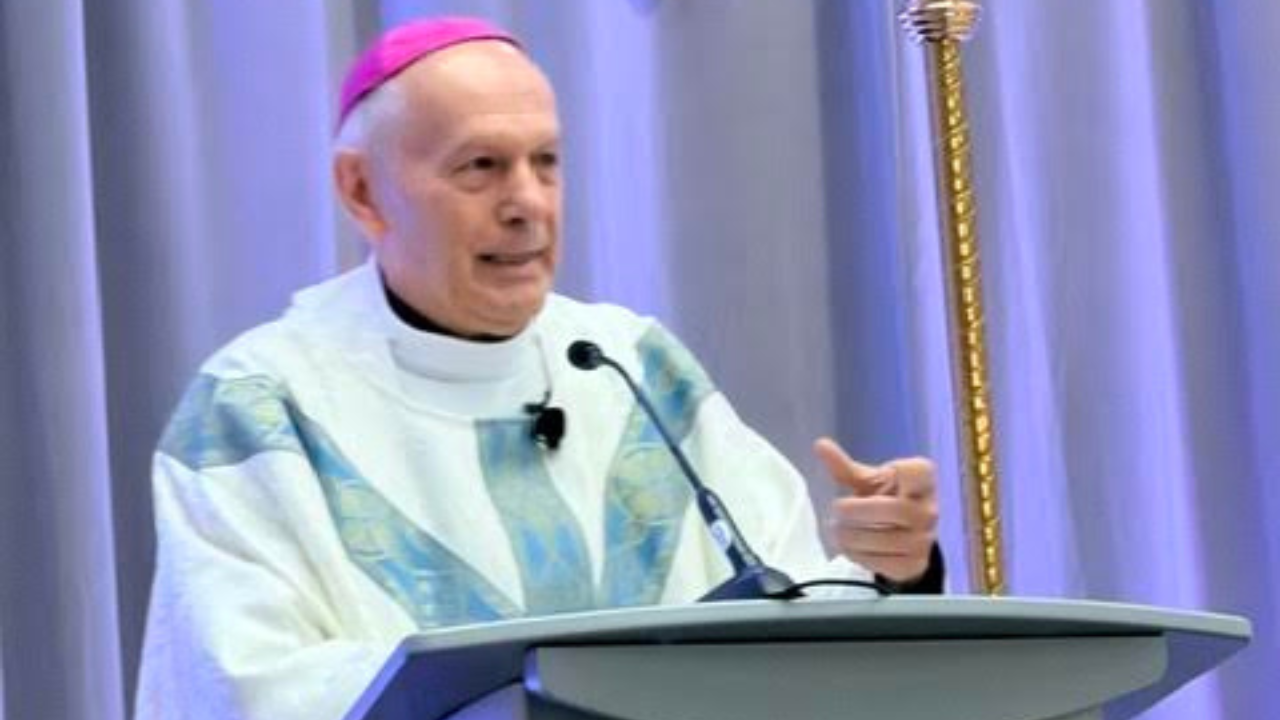
Written by Fr. Donald Paradis, M.S.
December 22, 2025, Monday of the Fourth Week of Advent
Lectionary #198, Luke 1: 46-56
Scripture
Mary said:
“My soul proclaims the greatness of the Lord; my spirit rejoices in God my savior, for he has looked upon his lowly servant. From this day all generations will call me blessed: the Almighty has done great things for me, and holy is his Name. He has mercy on those who fear him in every generation. He has shown the strength of his arm, and has scattered the proud in their conceit. He has cast down the mighty from their thrones and has lifted up the lowly. He has filled the hungry with good things, and the rich he has sent away empty. He has come to the help of his servant Israel for he remembered his promise of mercy, the promise he made to our fathers, to Abraham and his children for ever.”
Mary remained with Elizabeth about three months and then returned to her home.
Reflection
A most unusual episode in the Hebrew Scripture begins our reflection today. Hannah had prayed and prayed for a child. At last, she gives birth to a son and names him Samuel. A few verses after, we read of her gratitude to God, and also learn that she left her own flesh and blood at God’s shrine.” I prayed for this child, and the Lord granted my request. Now, I in turn give him to the Lord; as long as he lives, he shall be dedicated to the Lord.”
Samuel grew up to become early Israel’s greatest leader, a judge who brought God’s wisdom to the tribes, and a prophet who brought God’s word to everyone. But we are left at the close of the first reading in mystery, wondering how a mother could do such a thing, could give up her only son for so uncertain a future. She let God use her flesh to bring wisdom and guidance to a people in search of direction.
The Gospel is a continuation of Luke’s incredible narrative about two women of outstanding faith, Elizabeth and Mary. Like Hannah, Mary, and Elizabeth bore sons. Like Hannah, both gave them over to God’s service as powerful preachers of dangerous truth, as credible witnesses to God’s wisdom. Just as Samuel had reversed the flow of history by his leadership in Israel, both John the Baptist and Jesus initiated a series of dramatic reversals: from sin to holiness, from aimless wandering to the pathway of righteousness, from estrangement to communion with God.
Mary’s Canticle sings of these reversals: the power of God is a transforming power, it undoes the direction of history, it changes the human heart. The poor will be well-to-do, the hungry will eat well, the haughty will be humbled, the high and the mighty will be brought low.
In summing up her own faith and trust in the God of history, Mary sums up the faith we share as God’s people today. While the Eternal Word is taking flesh in her it is becoming part of us.
Women of faith in the Bible have such hard stories to tell. Despite peril, puzzlement, and tragedy, each of them seeks God’s will and does it, each in her own way, allowing the plan of salvation to be fulfilled. Whoever does the will of God, Jesus assures us, is brother and sister and mother to him!
From the Rule of the La Salette Missionaries, we hear our common call as reconcilers, “We are called to be a sign and instrument of the work of Reconciliation accomplished by Christ and with which Mary, as she reminds us in her Apparition, is so closely associated” (#22).
Again, the Rule states: “Christ came to bring the Good News of freedom to all people while turning in a special way to the poor and the oppressed. Mary, at La Salette, while speaking to the lowly and the humble made her message known to all her people. We also direct our mission to the People of God as a whole, while turning more willingly in our apostolic endeavors towards those the world looks down upon and towards those who are alienated from God and the Church” (#25).
La Salette Invocation
Our Lady of La Salette, reconciler of sinners,
pray without ceasing for us who have recourse to you.